Posts

Showing posts with the label Volatility Index

Riding the Volatility Wave: A VIX-Based Approach to Election Investing

Image
Here's the Real Reason Treasury Yields Are Rising (YouTube link ) Yield Curve Mystery: Why Did Yields Rise After the Fed Cut? The speakers in the video above are discussing the recent rise in the 10-year Treasury yield following the Federal Reserve's 50-basis-point interest rate cut. They propose four potential explanations for this unexpected yield increase: A Head Fake: The yield rise is temporary and will soon reverse. Bond Vigilantes: Investors are concerned about rising deficits and national debt, leading them to demand higher yields on government bonds. Market Repositioning: Investors who had bet on a recession are now selling bonds as the economic outlook improves. A New Market Paradigm: Investors are anticipating higher growth and inflation in 2025, leading to increased demand for higher-yielding bonds. The speakers from  DataTrek Research  lean towards the third or fourth explanation, suggesting that the market is shifting towards a new paradigm of stronger e...

Move Index—Bond Market Volatility

Image
Many of us are familiar with the VIX Index, commonly referred to as the “Fear Index”.  The VIX Index is a measure of “fear” as that relates to equity markets and typically rises during periods of falling prices, sometimes sharply during more precipitous declines.   Move Index Did you know there's an index that gauges fear in the bond market? Originally created by Merrill Lynch, it's now called the  ICE BofAML  MOVE  Index . This index measures how much investors expect interest rates to fluctuate. When there's worry about rising rates, the index goes up. It climbed sharply during the 2013 Taper Tantrum, reflecting heightened concerns about interest rate increases. The index rises as concerns grow that interest rates are on the march higher. The index will rise more sharply when there are fears in the market that rates may be headed significantly higher as was the case during the 2013 Taper Tantrum. Key Points to Understand: Implied Volatility: The MOVE Index...

Index Liquidity versus Volatility Level

Image
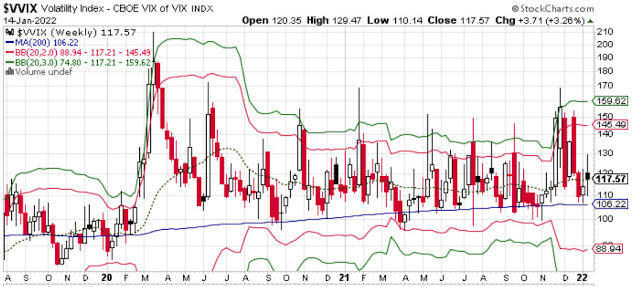
Market liquidity refers to the depth of buy and sell orders. A liquid market is one where you can buy or sell quickly. Volatility refers to a market's rate of change. A volatile market is one in which price changes rapidly over a short period of time.  Basically, the relationship between liquidity and volatility can be summarized as: Volatility  is related to several factors, and  liquidity  is only one of them In the context of  volatility , it means that there are always plenty of buyers and sellers whenever someone wants to buy or sell. Liquidity  keeps the bid-ask spread small. Liquidity by itself may not reduce the volatility of a stock, but a lack of liquidity can definitely cause wild volatility. Figure 1.   CBOE VIX of VIX Index (Source: stockchart.com) Volatility and the Amount of Consensus on Market Valuations In [3], Steve Sosnick wrote that the amount of volatility is inversely proportional to the amount of consensus about market v...